
Ahead of print

Case report

Retinitis Pigmentosa Sine Pigmento Masquerading as Normal-Tension Glaucoma. A Case Report

Full Text links

Summary

Aim: The aim of this publication is to highlight the diagnostic pitfalls in differentiating retinitis pigmentosa sine pigmento (RPSP) from normal-tension glaucoma (NTG).

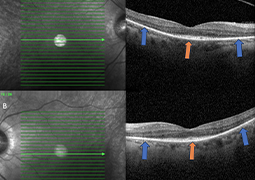
Case Report: A 71-year-old patient was treated for 10 years with topical dual antiglaucoma therapy for NTG, which had been diagnosed based on optic disc pallor, a cup-to-disc ratio of 0.6, normal intraocular pressure, and visual field defects. During the course of subsequent monitoring, the patient developed progressive nyctalopia, concentric visual field constriction, and a marked decline in visual acuity from 1.0 to 0.1. Multimodal imaging, including fundus autofluorescence (FAF), optical coherence tomography (OCT), and perimetry, demonstrated photoreceptor degeneration that did not correlate with glaucomatous optic neuropathy. Genetic testing identified two heterozygous variants in the USH2A gene: one known pathogenic variant (c.11864G>A) and one novel variant (c.12544A>G). Based on these findings and the absence of typical bone spicule pigmentation on fundus examination, a diagnosis of RPSP was determined.

Conclusion: This case underscores the risk of misdiagnosing RPSP as NTG due to overlapping clinical features, and emphasizes the necessity of comprehensive multimodal evaluation, including FAF, OCT, electroretinography, perimetry, and genetic testing, in order to ensure accurate diagnosis and appropriate management.

References

  1. Weleber RG, Gregory-Evans K. Retinitis pigmentosa and allied disorders. In: Ryan SJ, ed. Retina, 4th edn. Philadelphia, PA: Elsevier. 2006:p.394-485.
  2. O’Neal TB, Tripathy K, Luther EE. Retinitis Pigmentosa. In: StatPearls [Internet]. StatPearls Publishing; 2025. Available from: https://www.ncbi.nlm.nih.gov/books/NBK519518/
  3. Lee BL, Bathija R, Weinreb RN. The definition of normal-tension glaucoma. J Glaucoma. 1998;7(6):366-371.
  4. Killer HE, Pircher A. Normal tension glaucoma: review of current understanding and mechanisms of the pathogenesis. Eye (Lond). 2018;32(5):924-930.
  5. D’Esposito F, Gagliano G, Gagliano C et al. Usher Syndrome: New Insights into Classification, Genotype-Phenotype Correlation, and Management. Genes (Basel). 2025;16(3):332.
  6. Ruiz-Matos SJ, Ruiz-Justiz AJ, Izquierdo N. Retinitis Pigmentosa Sine Pigmento in a Patient with a Heterozygous Mutation on the KIF7 Gene: A Case Report. Cureus 2024;16(6):e62689.
  7. Ayala Rodríguez SC, Ramirez Marquez E, Robles Bocanegra A, Izquierdo N, Oliver AL. Retinitis Pigmentosa Sine Pigmento in a Carrier of Usher Syndrome. Cureus. 2023;15(4):e37719.
  8. Lee EK, Lee SY, Ma DJ et al. Retinitis pigmentosa sine pigmento: Clinical Spectrum and Pigment Development. Retina. 2022;42(4):807- 815.
  9. Tong JM, Chan CKM, Leung DY et al. Retinitis Pigmentosa Sine Pigmento Masquerading as Normal Tension Glaucoma. J Curr Glaucoma Pract. 2008;60-61.
  10. Lu Y, Sun X. Retinitis pigmentosa sine pigmento masqueraded as myopia: A case report (CARE). Medicine (Baltimore). 2021;100(3):e24006.
  11. Pellegrini F, Prosdocimo G, Romano F, Interlandi E. Retinitis Pigmentosa Sine Pigmento Mimicking a Chiasm Disease. Neuroophthalmology. 2017;41(4):198-201.