
2020 - 2 Issue

Original article

Primary Intrabulbar Neurofibroma

Full Text links

Summary

Purpose: Enucleation of the eyeball for any reason other than malignant tumour is very rare today. Solitary intrabulbar neurofibroma without other signs of neurofibromatosis is a rare benign tumour, and only few cases have been published to date.

Material and Methods: Within a ten-year interval from 1 January 2007 to 31 December 2016 we analysed enucleation of the eyeball for reasons other than malignant tumours.

Results: Out of a total number of 49 enucleated blind eyes, in every patient visual acuity was without light perception. Of these patients 34 (69.4 %) were indicated for enucleation due to complications following previous post-traumatic surgery, in 14 patients (28.6 %) the reason was secondary glaucoma and other complications following previous intraocular surgery, and in one patient (2 %) a primary isolated intraocular neurofibroma was verified after enucleation.

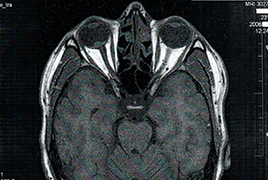
Case Report: A patient with isolated intrabulbar neurofibroma was monitored from childhood age due to an intraocular lesion, which was histologically verified only in adult age. At the time of enucleation the patient was aged 25 years, he had squinted since childhood and since the age of 13 years had been monitored due to hamartoma in the right eye. Due to progression of the intrabulbar lesion, loss of visual acuity (functional condition – eye without light perception) and secondary glaucoma, the right eyeball was enucleated in adult age and subjected to a histopathological examination, which determined intraocular neurofibroma without the presence of neurofibromatosis.

Conclusion: It is necessary to subject every enucleated eyeball to a thorough histopathological examination. Isolated intraocular neurofibroma may occur as an isolated orbital or intrabulbar mass, without systemic features.

References

  1. Alkatan, HM.: Solitary neurofibroma in the absence of neurofibromatosis. Can J Ophthalmol, 42 (4);2007:628–9.
  2. Alshomar, KM., Alkatan, HM., Alsuhaibani, AH.: Bilateral orbital isolated (solitary) neurofibroma in the absence of neurofibromatosis - A case report. Saudi J Ophthalmol, 32 (1);2018:83–5.
  3. Baráková, D., Krásný, J., Kuchynka, P. et al.: Nádory oka. Praha, Grada Publishing. 2002,152 p.
  4. Castellanos, E., Plana, A., Carrato, C. et al.: Early Genetic Diagnosis of Neurofibromatosis Type 2 From Skin Plaque Plexiform Schwannomas in Childhood. JAMA Dermatol, 154 (3);2018:341–6.
  5. Chawla, U., Khurana, AK., Anand, N. et al.: A rare case of a solitary intraocular neurofibroma. Nepal J Ophthalmol, 5 (2);2013:262–4.
  6. Čmelo, J.: 3D – trojrozmerná ultrazvuková diagnostika oka a očnice [3D ultrasonography diagnostics of the eye and orbit]. Cesk Slov Oftalmol, 64 (5);2008:188–192.
  7. Damato, B.: Recent Developments in Ocular Oncology. In Grzybowski, A. (Ed), Current Concepts in Ophthalmology. Springer International Publishing, 2020,p. 275–93.
  8. DiMario, FJ., Ramsby, G.: Magnetic resonance imaging lesion analysis in neurofibromatosis type 1. Arch Neurol, 55 (4);1998:500–5.
  9. Ehara, Y., Koga, M., Imafuku, S. et al.: Distribution of diffuse plexiform neurofibroma on the body surface in patients with neurofibromatosis 1. J Dermatol, 47(2);2020:190–2.
  10. Furdová, A., Oláh, Z.: Nádory oka a okolitých štruktúr. Brno, Akademické nakladatelství CERM,2010,152 p.
  11. Jendi, SK., Khatib, S., Mistry, J. et al.: Ossifying Fibroma of Maxilla in a Female Affected by Neurofibromatosis Type 1. Indian J Otolaryngol Head Neck Surg, 71 (Suppl 3);2019:2087–90.
  12. Matejcik, V.: Our experience with surgical treatment of the schwannomas of peripheral nerves. Bratisl Lek Listy, 103 (12);2002: 477–9.
  13. Matejcík, V.: Tumory periférnych nervov končatín a brachiálneho plexu a ich chirurgické riešenie [Tumors of peripheral nerves of extremities and the brachial plexus and their surgical treatment]. Rozhl Chir, 81 (10);2002:538–543.
  14. Matejcík, V., Benetín, J., Danis, D.: Our experience with surgical treatment of the tumours of peripheral nerves in extremities and brachial plexus. Acta Chir Plast, 45 (2);2003:40–5.
  15. Muir, D., Neubauer, D., Lim, IT. et al.: Tumorigenic properties of neurofibromin-deficient neurofibroma Schwann cells. Am J Pathol, 158 (2);2001:501–13.
  16. Ramdurg, P., Puranik, SR., Dantu, R. et al.: Solitary Neurofibroma of the Soft Palate: A Rare Entity. Indian J Otolaryngol Head Neck Surg, 71 (Suppl 1);2019:38–41.
  17. Rootman, J.: Neoplasia. In: Diseases of the Orbit: A Multidisciplinary Approach. Philadelphia, Lippincott Williams & Wilkins, 2003, p. 213–61.
  18. Rose, GE., Wright, JE.: Isolated peripheral nerve sheath tumours of the orbit. Eye Lond Engl, 5 (Pt 6);1991:668–73.
  19. Shields, JA., Shields, CL., Lieb, WE. et al.: Multiple orbital neurofibromas unassociated with von Recklinghausen’s disease. Arch Ophthalmol, 108 (1);1990:80–3.
  20. Sleiman, Z., Abboud, L., Mehanna, E. et al.: Mandibular neurofibroma: Case report of a rare tumor. Clin Pract, 9 (4);2019:1143.
  21. Stough, JT.: Intra-ocular neurofibroma: report of a case. Arch Ophthalmol, 18 (4);1937:540–6.