
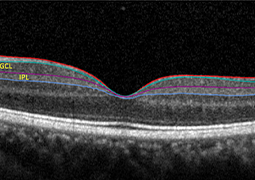

Aims: To evaluate the association between aqueous humor tumor necrosis factor alpha (TNF-α) and retinal ganglion cell (RGC) layer in patients with juvenile open-angle glaucoma (JOAG) and their comparison with adult-onset primary open-angle glaucoma patients (POAG).
Material and Methods: This analytical cross-sectional study included 15 JOAG patients (aged 7–40 years) and 15 POAG patients (> 40 years). Aqueous Humor (AH) samples were collected during trabeculectomy, TNF-α concentrations were measured using ELISA, and RGC thickness was assessed by Optical Coherence Tomography (Cirrus HD-OCT, Carl Zeiss). Group differences were analyzed using the independent t-test, and correlations were evaluated with Pearson’s test.
Results: The mean AH TNF-α level in the JOAG group (179.02 ±27.04 pg/mL) was significantly higher than in the POAG group (130.17 ±18.62 pg/mL; p < 0.001). Mean RGC thickness in JOAG (42.87 ±8.29 µm) was significantly lower than in POAG (58.13 ±14.86 µm; p = 0.004). There was a strong negative correlation between TNF-α levels and RGC thickness in both JOAG (r = -0.726; p = 0.02) and POAG (r = -0.807; p < 0.001).
Conclusion: Higher intraocular TNF-α levels and reduced RGC thickness in JOAG suggest a prominent neuroinflammatory contribution to early-onset glaucoma. Targeting TNF-α-mediated pathways may offer potential neuroprotective benefits in younger glaucoma patients.