
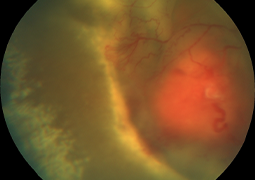

Aims: To evaluate retrospectively the clinical characteristics and therapeutic outcomes in eyes with secondary vasoproliferative retinal tumors (VPRT) at a tertiary center in Turkey.
Material and Methods: Patients diagnosed with secondary VPRT between 2005 and 2025 with a follow-up of 6 months or more were included. 24 eyes of 21 patients were evaluated. Their charts and multimodal imaging features were analyzed, and treatments noted.
Results: Mean age was 26.1 years (6–57). Mean follow-up was 61.1 months (6–151). Baseline BCVA was 0.77 LogMAR (0.00–2.30). VPRT was linked to non-infectious uveitis in 12 patients, retinitis pigmentosa in 5 patients, X-linked Juvenile Retinoschisis, Coats’ disease, retinal dystrophy and retinopathy of prematurity in 1 patient each. The inferotemporal quadrant was the most common site (66.7%). Treatments included dexamethasone implant, transscleral cryotherapy, systemic immunosuppressive therapy, laser photocoagulation, CyberKnife, intravitreal anti-VEGF, vitreoretinal surgery, photodynamic therapy, intravitreal triamcinolone acetonide and enucleation. At baseline, 15 eyes had macular intraretinal fluid. At the final visit, dry macula was achieved in 9 of 15 eyes. Mean final BCVA was 1.01 LogMAR (0.00–3.00). Two eyes deteriorated to no light perception. One was enucleated.
Conclusion: This largest cohort of patients from Turkey with secondary VPRT reflects the diverse underlying etiologic associations and heterogeneous clinical manifestations at a tertiary center. Various therapeutic techniques were required to cope with this difficult-to-treat, challenging disease entity.